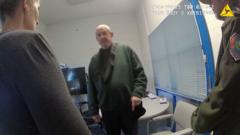
Imagine standing before a judge while trapped inside a television screen. You are handcuffed. Heavy metal shackles bind your ankles. Your body is a fragile shadow of what it used to be. You have lost forty kilograms of weight. Your glasses were taken away months ago, leaving your surroundings a permanent, terrifying blur. This isn't a dystopian movie plot. This is the current reality for Dr Hussam Abu Safia, the director of Kamal Adwan Hospital in northern Gaza. He has been locked away in an Israeli prison system for well over 500 days without a single formal charge.
The world often looks at the crisis in Gaza through cold statistics. We count destroyed buildings and track casualty numbers on digital dashboards. But the systematic targeting and prolonged imprisonment of medical professionals tells a far deeper story about the total collapse of international humanitarian protections. When a prominent pediatrician and hospital leader can be snatched from his ward, thrown into solitary confinement, and held indefinitely on secret evidence, it means the rules governing global warfare are completely broken.
The Broken Health System and the Fate of Dr Hussam Abu Safia
To understand how Dr Hussam Abu Safia ended up in an Israeli prison cell, you have to look at what happened to Kamal Adwan Hospital during the final months of 2024. As the last functioning medical facility in northern Gaza, the hospital became an island of survival. Dr Abu Safia stayed behind to treat children and critically injured patients while a brutal, multi-month military siege ground down the surrounding neighborhoods.
He didn't just manage the facility. He became its living symbol. He regularly recorded desperate video appeals on his phone, showing the world the empty medicine cabinets, the dark operating rooms running without fuel, and the bodies of children stacked in the courtyard.
His commitment to his patients was intensely personal. In October 2024, an Israeli drone strike hit the entrance of the hospital. The blast killed his 15-year-old son, Ibrahim. Instead of leaving or retreating into grief, Dr Abu Safia kept working. His colleagues noted that he wore his blood-stained white doctor's coat for weeks, refusing to wash away the last physical trace of his son.
When the Israeli military carried out a final forced evacuation of the hospital on December 27, 2024, Dr Abu Safia walked out to meet the tanks. He shook hands with a soldier and confirmed that the building was empty of patients before he was taken away for interrogation. The military claimed the hospital was used by combatants. The medical staff flatly denied the accusation. Since that winter afternoon, he hasn't breathed a single breath of free air.
The Dark Legal Void of the Unlawful Combatants Law
The state of Israel holds Dr Abu Safia under a legal mechanism known as the Unlawful Combatants Law. This is not a standard criminal framework. It strips detainees of the basic rights guaranteed under the Geneva Conventions. It allows authorities to hold individuals indefinitely without ever bringing formal charges or presenting open indictments.
The law creates a structural wall that blocks justice. When his attorney, Nasser Odeh, stands up in court to demand his release, the military prosecution simply hands the judge a folder of confidential files. The defense lawyer cannot see this evidence. The prisoner cannot see it. The public cannot see it. The prosecution merely asserts that releasing the doctor would threaten national security, and the courts routinely rubber-stamp the request.
In June 2026, Israel's Supreme Court heard another appeal regarding his case. The court rejected the plea and extended his administrative detention until at least October 2026. This means his imprisonment can be renewed every few months forever. It is an administrative loop designed to keep individuals hidden from the world.
From the Pediatrics Ward to a One-Meter Cell
The physical toll of this indefinite detention is horrifying. When Dr Abu Safia briefly appeared via video link during his June court hearing, his family saw him for the first time in months. The transformation shocked them. He was emaciated and visibly weakened.
Information gathered by groups like Physicians for Human Rights Israel painted a grim picture of his daily life. Since early June 2026, authorities transferred him to a solitary confinement cell in Ganot prison. The cell measures barely one meter by one meter. There is not enough room to stretch out or walk. It is a concrete box meant to break a person's psychological resolve.
His medical condition is worsening by the day. He suffers from a chronic illness that requires regular medication, which he hasn't received. His left thigh still contains shrapnel from a wound he received around the time of his arrest, causing persistent swelling and severe pain. He has severe neck and back injuries stemming from physical assaults during his early months in Ofer prison, where he was forced to sit on sharp gravel for hours and beaten with batons. Due to the terrible hygiene conditions and lack of clean water, painful skin diseases have spread across his hands and body.
Why Every Healthcare Worker in the World is at Risk
This case isn't just an isolated tragedy in a war zone. It sets a dangerous precedent for international law. Under global treaties, hospitals and medical workers are supposed to be protected neutral actors. They treat the wounded regardless of political affiliation.
When international bodies allow a hospital director to be locked up for over 17 months without trial, it signals that medical neutrality no longer exists. If a doctor can be classified as an illegal combatant simply for refusing to abandon patients in an intensive care unit, then no medical worker in any future conflict is safe.
United Nations experts like Special Rapporteurs Tlaleng Mofokeng and Ben Saul have explicitly called his detention flagrantly arbitrary. They pointed out that his treatment violates the Mandela Rules, which govern the minimum standards for treating prisoners. Prolonged solitary confinement beyond 14 days is legally recognized as a form of torture. Dr Abu Safia has long passed that threshold.
What Needs to Happen Next
Vague statements of concern from international leaders won't open the doors of Ganot or Nafha prison. If you want to see an end to this arbitrary detention, clear and direct actions must be taken to pressure the authorities.
First, international medical associations must leverage their collective influence. The World Medical Association and the World Health Organization need to formally condition their institutional cooperation with Israeli medical entities on the fair treatment and release of detained healthcare workers. Professional solidarity must mean something concrete.
Second, citizens can join active campaigns run by human rights organizations. Amnesty International maintains an open global petition specifically demanding the immediate release of Dr Abu Safia and an end to the abuse of the Unlawful Combatants Law. Signing these petitions and writing to local elected officials keeps the case on the diplomatic agenda.
Third, legal groups must continue backing international arrest warrants and legal challenges. Human rights coalitions have already petitioned foreign ministries to hold individual officials accountable for the systematic targeting of Gaza's medical infrastructure. Keeping the legal pressure high ensures this case cannot be quietly brushed under the rug.
Dr Abu Safia spent his life saving newborn babies and protecting vulnerable children. He stayed in a collapsing hospital because he believed in the ethical duty of his profession. Leaving him to rot in a tiny solitary cell is a collective failure that we cannot afford to accept.
You can learn more about the ongoing legal battle and view video reports on his recent court appearance by checking this broadcast covering Dr Hussam Abu Safia appearing before the Israeli Supreme Court, which details his physical condition and the legal arguments presented by his counsel.