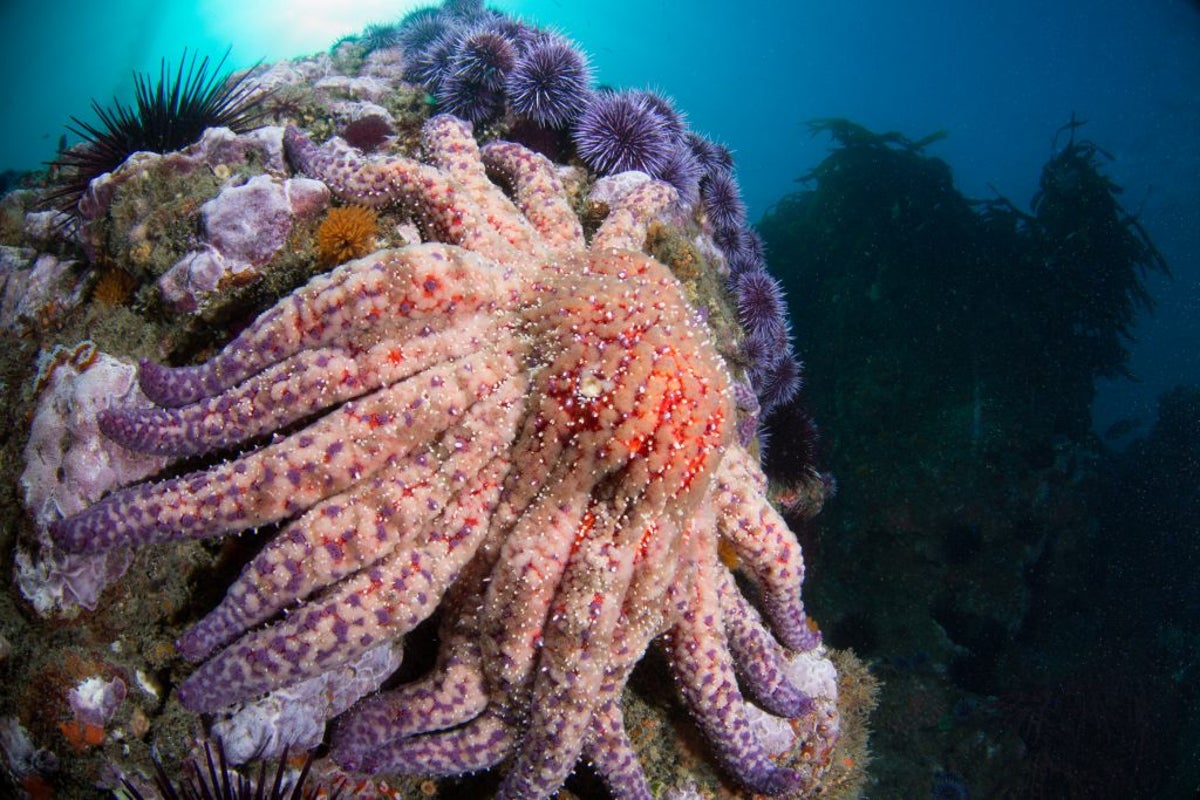
Imagine diving into a familiar coastal cove and screaming into your scuba regulator because you just saw a ghost. That is exactly what happened to marine researchers on the Sonoma County coast. They found a hidden population of sunflower sea stars, creatures so rare they were nicknamed the Sasquatch of the sea.
For a decade, these bizarre, multi-armed predators were completely missing from Northern California waters. A brutal combination of an ocean heatwave and a horrific wasting disease wiped out roughly 90 to 99 percent of them starting in 2013. Six billion animals dissolved into mush. Now, a tiny pocket of survivors has been mapped at Sea Ranch, and it changes everything we know about their chances of survival.
The Devastating Kelp Collapse
You cannot understand why this discovery is a big deal without looking at what happened when the stars died. Sunflower sea stars are not just decoration. They are ravenous, fast-moving hunters that can span three feet wide and travel three feet in a single minute. Their favorite food happens to be purple sea urchins.
When the sea stars vanished, the urchin population exploded by more than 10,000 percent. Without a predator to keep them in check, armies of urchins marched across the ocean floor, eating every single scrap of giant kelp and bull kelp in sight. They turned lush, underwater jungles into barren deserts known as urchin barrens.
Northern California lost about 96 percent of its kelp canopy. Commercial fisheries crashed. Red abalone, a culturally vital food source for local tribes like the Kashia Band of Pomo Indians, starved alongside the fish. The entire coastal food chain shattered because one heavy-hitting predator disappeared.
What Happened at Sea Ranch
The secret came out when a diver spotted a lone star in a quiet cove. Researchers from Sonoma State University quickly organized an intense, coordinated search effort dubbed Pycnopalooza. Twenty-five scientific divers from universities, tribal groups, and conservation nonprofits descended on the cove with flashlights and underwater grid systems.
They found eighteen sunflower sea stars.
Eighteen might sound small, but it is the largest, healthiest cluster found in California since the mass die-off. Crucially, the group includes massive adults and tiny juveniles. This means the stars are actively breeding in the wild again. Isolated individuals found over the last decade were essentially evolutionary dead ends. They were too far apart to reproduce. This cove is different. It is a functional, breeding colony.
Cracking the Genetic Code of Survivors
Scientists are not just celebrating; they are taking tissue samples. Divers carefully snipped small pieces of tissue from the eighteen stars before leaving them in peace. Those samples went straight to a genetics laboratory at the University of California, Merced.
Evolutionary ecologists are sequencing the DNA to answer a massive question. Why did these specific eighteen stars live while six billion others died?
A major breakthrough came when researchers identified the culprit behind the original plague. A bacterium called Vibrio pectenicida causes the tissue to blister, twist, and liquefy within days. If the Sea Ranch stars carry a specific gene that makes them immune or resistant to this bacterium, they could hold the blueprint for saving the entire species.
Laboratory Breeding and Reintroduction
While wild colonies are holding the line in hidden coves, an ambitious parallel effort is happening on land. The Pacific Coast Ocean Restoration Initiative has poured millions into captive breeding networks. Marine biologists at the California Academy of Sciences and the Sunflower Star Laboratory in Moss Landing are finally figuring out how to raise these animals from microscopic larvae into full-grown adults.
It is incredibly difficult work. The larvae are fragile, and keeping them alive requires creative engineering, like using modified electric pot stirrers to keep the water swirling perfectly. Once they grow into juveniles, their appetites are terrifying. A single young sea star the size of a hamburger bun can devour forty-four small sea urchins in a day, ballooning up before spitting out clean urchin skeletons.
The goal is to use these lab-raised populations to support wild recovery. Scientists have already started small test releases of captive-bred stars into places like Monterey Bay to see how they handle real ocean conditions.
How to Join the Search
You do not need a degree in marine biology to help track this recovery. Scientists desperately need more eyes on the water to find other hidden colonies.
- Use the iNaturalist app to upload clear, geotagged photos if you ever spot a multi-armed sea star while tidepooling or diving.
- Participate in the Solstice Sea Star Search organized by the California Academy of Sciences every June and December. Extreme low tides during these periods expose deep rocky reefs that are normally impossible to reach.
- Keep an eye out for colors ranging from bright orange to deep purple, and count the arms. Common ochre stars only have five arms, while a true sunflower star will have up to twenty-four.
Report any sightings immediately to local coastal conservation groups. Documenting where these animals are hiding is the fastest way to get their habitats legally protected before changing ocean temperatures spark another wave of disease.