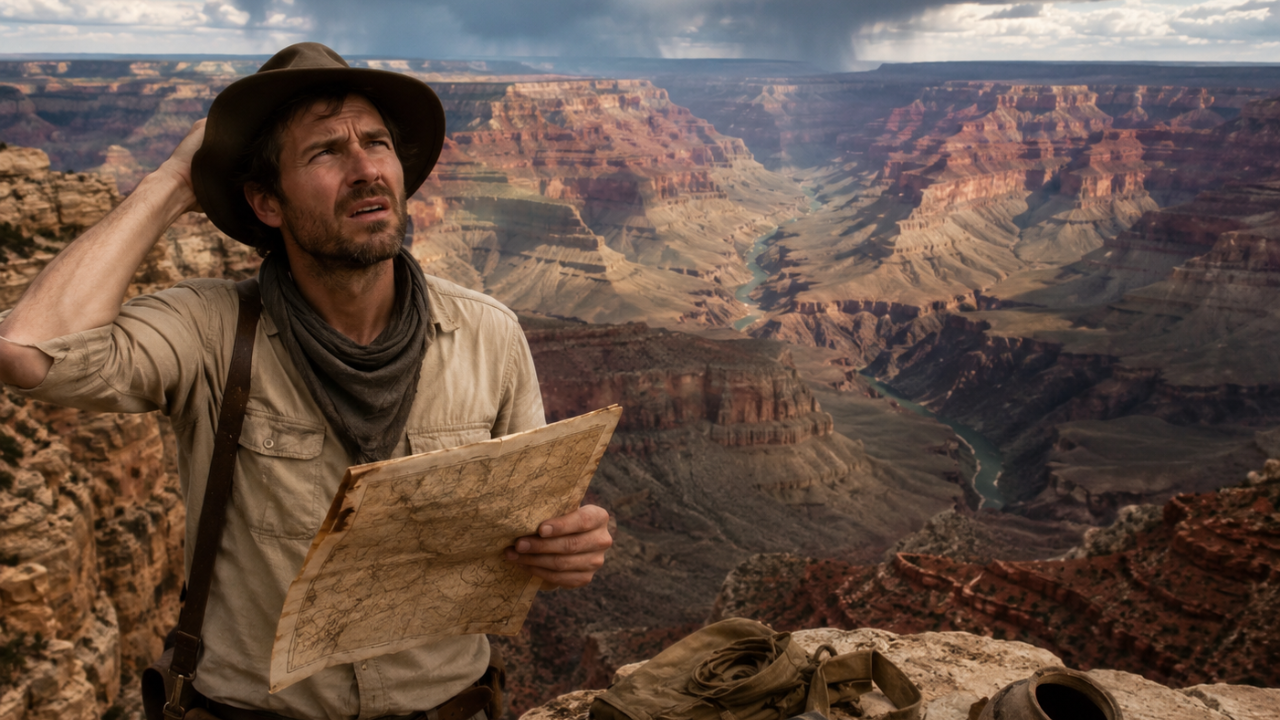
You have probably seen the viral videos or read the frantic forum threads. They claim that deep inside a restricted zone of the Grand Canyon, an ancient underground city contains Egyptian artifacts, mummies, and hieroglyphs. It sounds like an Indiana Jones plot. It claims that a massive government cover-up is keeping you from the truth.
Let's settle this immediately. No one ever found ancient Egyptian artifacts in the Grand Canyon. The entire legend is based on a single, thoroughly debunked newspaper hoax from 1909. There are no secret mummies, no hidden pharaohs, and no underground citadels hiding behind federal barriers.
People still fall for this story over a century later. Why does it stick around? The answers say more about the wild world of early American journalism and the psychology of conspiracy theories than they do about ancient Egypt.
The Wild Claims of the 1909 Arizona Gazette Article
The myth began on April 5, 1909. A local newspaper called the Arizona Gazette published a front-page story. The headline announced a massive archaeological discovery that would rewrite human history.
According to the anonymous writer, a river traveler and explorer named G.E. Kincaid was rafting down the Colorado River. He claimed to look up and spot a strange mineral stain on a cliff wall, roughly two thousand feet above the canyon floor. He climbed up, found a hidden entrance, and crawled inside.
What he supposedly found was staggering. The article described a sprawling underground citadel. It was carved directly into the rock. It was large enough to easily house fifty thousand people.
Kincaid claimed the tunnels were filled with astonishing treasures. He reported finding copper tools, weapons, and vast granaries filled with seeds. He saw an enormous central hall containing a massive statue that resembled Buddha. Even more shocking, he claimed to find rows of male mummies wrapped in dark shrouds, alongside clay tablets covered in mysterious Egyptian-style hieroglyphs.
The story claimed that the prestigious Smithsonian Institution quickly stepped in. They supposedly sent a lead archaeologist named Professor S.A. Jordan to oversee a massive, secret excavation. The article promised that this discovery would permanently link the history of Egypt and the Nile to the rugged canyonlands of Arizona.
Then came the silence.
The newspaper never ran a single follow-up piece. No photos were ever printed. No artifacts ever made it to a museum display case. For decades, the story simply vanished from public view until modern internet forums resurrected it as proof of a massive historical conspiracy.
Why the Smithsonian Conspiracy Theory Falls Apart
When you look closely at the 1909 article, the cracks appear instantly. The biggest red flag involves the institutions and people named in the text.
Conspiracy theorists love to claim that the Smithsonian cleared out the cave and hid the evidence to protect the mainstream historical narrative. They argue that the lack of public evidence is actually proof of a cover-up.
That is circular logic at its worst.
The Smithsonian Institution has repeatedly searched its historical directories, payrolls, letters, and archives. They have found absolutely nothing. There is no record of an explorer named G.E. Kincaid. There is no record of a Professor S.A. Jordan ever working for the organization. There are no field notes, no shipping logs, and no expense reports matching any Grand Canyon excavation from that era.
The original newspaper article even messed up the name of the organization it was trying to exploit. It repeatedly referred to the "Smithsonian Institute" instead of its actual legal name, the Smithsonian Institution. A real researcher from the organization would not make that mistake.
Archaeologists in 1909 did not have helicopters or advanced climbing gear. Think about the logistics. Moving thousands of heavy stone statues, copper tools, and fragile mummies out of a sheer cliff face two thousand feet above a rushing river would require an army of workers. It would require miles of ropes, heavy machinery, and pack mules.
Someone in the surrounding Arizona towns would have noticed. A massive operation like that leaves a giant paper trail. You would find train receipts, local hotel logs, grocery bills, and letters home from the workers. Yet, outside of that single page in the Arizona Gazette, there is absolutely nothing.
The Real Origin of the Egyptian Names in the Canyon
If there is no connection to Egypt, why do official maps of the Grand Canyon look like a guide to ancient mythology? Travelers hiking the rims often notice names like the Isis Temple, Tower of Ra, Cheops Pyramid, Horus Temple, and Osiris Temple assigned to various rock formations.
This is not a clue left behind by ancient sailors. It is the result of late nineteenth-century geological mapping practices.
During the late 1800s, geologists and cartographers were tasked with mapping the vast, labyrinthine stretches of the American West. A geologist named Clarence Dutton was one of the primary figures responsible for naming the dramatic buttes and mesas of the Grand Canyon.
Dutton was a highly educated man who loved world history, literature, and global mythology. When he looked at the massive, stepped stone towers rising from the canyon floor, he thought they looked like grand architectural monuments. He started naming them after ancient gods and structures from Egyptian, Hindu, and Norse mythology.
He gave these majestic shapes names like the Shiva Temple and the Vishnu Temple alongside the Egyptian titles. It was a poetic way to label a grand landscape. It had nothing to do with the actual people who lived there. Modern park authorities are working to contextualize these romanticized labels with the true history of the local tribes.
Yellow Journalism and the Art of the Media Hoax
To understand why the Arizona Gazette printed the story, you have to look at the state of American media in 1909. This was the era of yellow journalism. Newspapers routinely fabricated wild stories to boost their circulation, shock readers, and beat their local competitors.
In fact, fake news was an art form back then. Traveling salesmen and tricksters like Joe Mulhattan made entire careers out of feeding completely fabricated stories to bored small-town editors. Newspapers published articles about giant petrified men, sea monsters in local lakes, and hidden underground civilizations because readers loved them.
The Grand Canyon was the perfect backdrop for a hoax. It was vast, largely unexplored, and intensely mysterious to the average American living on the East Coast. It had thousands of actual caves that the public could not easily access.
The editors at the Arizona Gazette likely needed a sensational headline for a slow news day. They spun a wild yarn, sold a massive pile of newspapers, and then moved on to the next big story the very next week. They did not expect people to still be debating their fictional creations over a hundred years later.
The True Human History of the Grand Canyon
The biggest tragedy of the Egyptian myth is that it completely ignores the rich, verifiable human history of the region. You do not need to invent fake pharaohs to make the Grand Canyon historically significant.
Indigenous communities have lived in, traveled through, and cared for the Grand Canyon for thousands of years. Archaeological evidence proves that Paleo-Indians were hunting and gathering in the area over thirteen thousand years ago.
Groups like the Ancient Puebloans built intricate homes, granaries, and cliff dwellings throughout the canyon. They left behind beautifully crafted pottery, split-twig figurines, and vivid rock art that you can still see today.
Today, eleven distinct Native American tribes maintain deep cultural and spiritual connections to the Grand Canyon. The Hopi, Navajo, Havasupai, Hualapai, Southern Paiute, and Zuni peoples do not view the canyon as an empty wilderness or a playground for treasure hunters. It is their ancestral homeland.
When modern conspiracy theorists insist that the canyon's grandest archaeological secrets must belong to ancient Egyptians or Buddhists, they are engaging in a form of historical erasure. They are suggesting that the actual Indigenous peoples of the Southwest were incapable of creating a deep, lasting culture on their own.
What to Do Next if You Love Canyon Mysteries
If you want to explore the real, tangible mysteries of the Grand Canyon without falling for old newspaper hoaxes, change your approach.
First, stop looking for Kincaid's cave on alternative history forums. Spend your time reading the peer-reviewed research published by the Grand Canyon Historical Society or the National Park Service. They document real archaeological finds, from ancient split-twig figurines found in remote caves to historic mining operations.
Second, respect the land when you visit. The National Park Service restricts access to many caves and remote areas. This is not done to hide mummies or cover up alien technology. It is done because these areas are incredibly fragile. They contain critical wildlife habitats, roosting bat colonies, and sacred Indigenous sites that can be easily destroyed by curious foot traffic.
Third, support the cultural programs run by the park's traditional tribes. Visit the Desert View Intertribal Cultural Heritage Site during your next trip to the South Rim. Talk to Indigenous artisans, watch cultural demonstrations, and listen to the real history of the canyon from the people whose ancestors actually lived there. That is far more rewarding than chasing a century-old ghost story.