If you walk down the streets of Biddeford, Maine, or drive through the neighborhoods of Houston, Texas, you expect a certain baseline of safety. You expect that if you have not committed a crime, you will make it home to your family. But in July 2026, that basic expectation was shattered for two families in the span of just six days.
Under the banner of national security and immigration enforcement, federal agents from U.S. Immigration and Customs Enforcement (ICE) have turned local streets into active combat zones. The result? Two dead men who were never the targets of the operations in the first place.
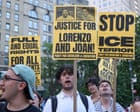
This is not a story about border security. It is a story about how a highly militarized, under-regulated federal agency is operating with terrifying autonomy inside American communities. The tragic deaths of Lorenzo Salgado Araujo and Joan Sebastián Durán Guerrero have ignited a fierce debate about the presence of ICE on American streets. If we look closely at the facts, it becomes clear that these are not isolated mishaps. They are the inevitable outcome of a system built on aggression and shielded from accountability.
The Fatal Toll of Mistaken Identity
To understand the scale of this crisis, we have to look at the human lives cut short. These were not high-profile fugitives. They were working-class men trying to earn a living.
On July 7, 2026, 52-year-old Lorenzo Salgado Araujo was driving his construction crew to a job site in Houston. Salgado Araujo had lived in the United States for 35 years. He was a father of three who had built a small business from the ground up. He was not the person ICE was looking for.
When unmarked vehicles blocked his path, Salgado Araujo tried to steer away. His family believe he thought he was being targeted by criminals. It is a rational fear for a construction worker carrying expensive tools. Instead of de-escalating, an ICE agent fired into the vehicle. Salgado Araujo died on the way to the hospital. The Department of Homeland Security (DHS) claimed he "weaponized his vehicle," a familiar piece of jargon used to justify the use of lethal force. Witnesses on the scene flatly disputed that claim.
Six days later, on July 13, the exact same script played out in Biddeford, Maine.
Joan Sebastián Durán Guerrero, a 26-year-old Colombian national, was leaving a residential building. He had a work authorization and a Social Security number. He lived with his partner and their young daughter. Again, he was not the target of the immigration warrant.
An ICE agent opened fire on Durán Guerrero's vehicle, claiming he tried to escape and use the car as a weapon. Witness videos and statements painted a different picture: Durán Guerrero was heard telling agents he was trying to stop his vehicle as they dragged him out. His young daughter, still wearing her pajamas, was left to witness the immediate aftermath of the violence.
Both men are dead. Both were completely innocent of the administrative warrants ICE was trying to execute.
A Bloodstained Pattern of Escalation
The Guardian's tracking of these incidents reveals a horrifying reality: Durán Guerrero was the 11th person killed by federal immigration officials since the start of the second Trump administration. The violence is escalating, fueled by a relentless drive for mass deportations and a culture of impunity.
Look at the timeline. In September 2025, a cook named Silverio Villegas González was shot and killed during a traffic stop in the suburbs of Chicago. DHS claimed he dragged an officer with his car, but later video footage showed the agent walking around the scene unharmed, treating the incident casually.
In January 2026, Renée Good, a mother of three and a U.S. citizen, was shot and killed by an ICE agent in Minneapolis during protests against the "Metro Surge" enforcement operations. Weeks later, Alex Pretti, a nurse, was shot and killed by Border Patrol agents in the same city.
This is a pattern. The administration has pushed ICE agents into local communities with immense pressure to produce arrest numbers. When you flood the streets with armed agents who are told they are fighting an invasion, every routine interaction becomes a high-stakes standoff.
Why Unmarked Pursuits are a Recipe for Disaster
The common thread in almost all of these fatal encounters is the use of unmarked vehicles and plainclothes operations.
Local police officers are bound by strict protocols regarding vehicle pursuits and traffic stops. They use marked cruisers, sirens, and distinctive uniforms so the public knows exactly who is pulling them over. ICE operates in a shadow. They routinely use unmarked SUVs, tactical gear with minimal markings, and civilian clothing.
When an unmarked vehicle aggressively blocks your car in a parking lot or on a side street, your first instinct is not "this is a federal law enforcement officer executing an administrative warrant." Your instinct is survival. You think you are being carjacked, robbed, or assaulted.
If you try to drive away to escape what you perceive as a violent crime, ICE agents interpret that flight as a threat. They claim you have "weaponized your vehicle" and open fire. It is a lethal trap. The agency creates the terror, panics the victim, and then uses that panic to justify pulling the trigger.
The Administrative Warrant Loophole
Many people do not realize that ICE warrants are not like criminal warrants.
A criminal warrant is signed by a neutral judge who has reviewed evidence of a crime and determined there is probable cause for an arrest. ICE warrants are administrative. They are signed by ICE officers themselves. They do not carry the same legal authority as a judicial warrant.
Because they lack judicial authority, ICE agents cannot legally enter a private home without consent. To get around this, they rely on street-level operations. They conduct surveillance, wait for someone to leave a residence, and then execute a traffic stop or intercept them on the sidewalk.
This bypasses the constitutional protections that protect us in our homes. It drags the enforcement action into the public square, where the risk of bystander casualties and mistaken identity skyrockets. If ICE were forced to obtain judicial warrants signed by actual judges before making arrests, the number of reckless, street-level ambushes would drop overnight.
The Illusion of Reform
In the wake of the public outcry over the deaths in Texas and Maine, federal immigration officials announced a temporary pause on most vehicle stops. They also promised to accelerate the rollout of body-worn cameras for field agents.
Do not be fooled. These are public relations gestures designed to quiet the outrage until the news cycle moves on.
A "temporary pause" does nothing to address the core issue: a rapidly expanded, undertrained force operating under politically motivated arrest quotas. Once the spotlight fades, the stops will resume.
Body cameras are a step toward transparency, but they do not stop bullets. The agents who shot Lorenzo Salgado Araujo and Joan Sebastián Durán Guerrero were not wearing body cameras. Even when footage exists, federal agencies have a long history of withholding, delaying, or heavily editing video releases to protect their officers.
Real safety does not come from recording the violence. It comes from stopping the violence at its source.
How to Protect Your Community from ICE Overreach
We cannot rely on federal agencies to police themselves. Real protection starts at the local level, with organized community defense and bold municipal policies. Here is how we can push back.
1. Know Your Rights on the Street
If you are pulled over or approached by ICE, you have constitutional rights, regardless of your immigration status.
- You have the right to remain silent. You do not have to answer questions about where you were born, how you entered the country, or your legal status.
- Do not run or resist physically. This is crucial. As we have seen, agents will use any movement as an excuse to escalate to lethal force.
- Ask if you are free to go. If the agent says yes, calmly walk away.
- Do not consent to a search. Calmly and clearly state, "I do not consent to a search of my vehicle" or "I do not consent to a search of my person."
2. Document and Record
If you witness an ICE operation, pull out your phone and record it.
- Keep a safe distance so you do not interfere with the operation, but ensure you have a clear line of sight.
- Note the license plates of the vehicles, the badges or tactical vests of the agents, and the exact time and location.
- Bystander video is often the only thing that stands between the truth and a fabricated federal cover-up.
3. Demand Sanctuary Policies from Local Officials
Municipalities have the power to limit cooperation with federal immigration enforcement. Pressure your city council and local sheriff to implement strict sanctuary policies.
- Prohibit local police from sharing resources, databases, or personnel with ICE.
- Ban local law enforcement from participating in joint operations or helping ICE execute administrative warrants.
- Ensure that municipal employees are instructed never to ask about immigration status.
4. Support Grassroots Rapid Response Networks
Many cities have local rapid-response hotlines run by immigrant rights organizations. Volunteer, donate, or help spread the word about these networks. When an ICE presence is spotted, these groups deploy trained observers to document the interaction and provide immediate legal support to those targeted.
The deaths of Lorenzo Salgado Araujo and Joan Sebastián Durán Guerrero are a grim reminder of what happens when we allow a federal agency to operate like an occupying army in our neighborhoods. A system that kills innocent workers in the name of administrative enforcement is fundamentally broken. It is time to stop accepting the excuses, stop relying on empty promises of reform, and demand that ICE be removed from our streets once and for all.