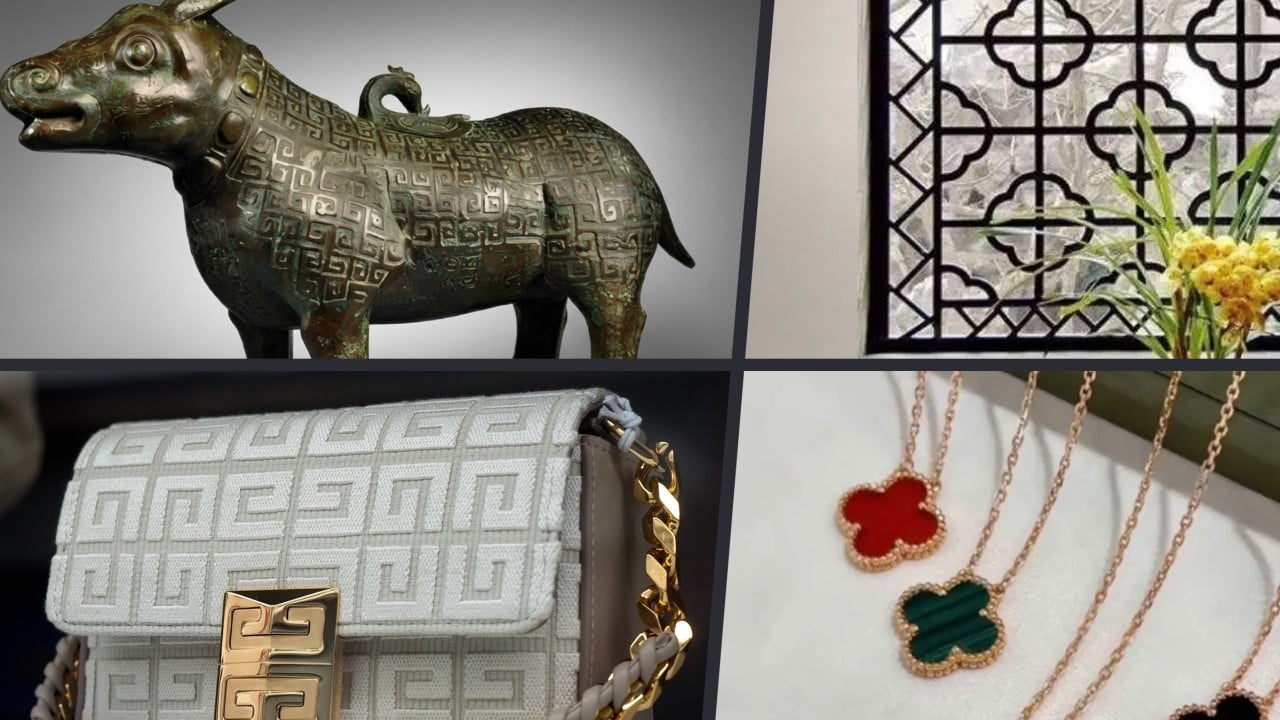
When a Suzhou court ordered Chinese tea chain Molly Tea to pay Louis Vuitton 10.3 million yuan—roughly 1.5 million US dollars—for trademark infringement, the internet exploded with indignation.
The cause of the lawsuit was a simple four-petal floral pattern.
Chinese social media users quickly posted photos showing identical motifs carved into Tang dynasty musical instruments, embroidered on thousand-year-old silks, and integrated into traditional Suzhou garden architecture. All of those historic artifacts predate Louis Vuitton’s 1854 founding date by hundreds of years. Yet under modern trademark law, the French luxury house owned the commercial right to that mark.
This wasn't an isolated incident. Back in 2022, French fashion giant Dior released a $3,800 pleated skirt and called it a "hallmark Dior silhouette". Hanfu enthusiasts and Chinese historians immediately recognized the exact structural design of the mamianqun, or traditional horse-face skirt, worn by Chinese women since the Song and Ming dynasties.
Dior didn't just borrow a motif. They claimed they invented the cut.
The tension between international intellectual property frameworks and historical visual heritage has reached a boiling point. Global brands regularly draw inspiration from Eastern history, but when Chinese creators attempt to use imagery born from their own ancestral culture, they risk getting sued by Western fashion conglomerates holding modern trademark registrations.
Protecting historical designs in a modern commercial system requires understanding where the law ends, where cultural ethics begin, and how creators can build defense mechanisms that actually work.
The Legal Trap Behind Public Domain Motifs
Why do legal courts favor Western brands when ancient history clearly shows earlier use?
It comes down to how trademark law functions. Trademark law does not exist to award who drew a shape first. It exists to protect the commercial indicator of origin. When a brand registers a mark and spends decades spending millions on advertising, that specific arrangement of visual elements identifies their business in the marketplace.
Ancient motifs exist in the public domain. That means anyone can theoretically use them. But when a modern company turns a public domain pattern into a registered corporate logo under a first-to-file legal system, they gain legal exclusivity over that specific commercial application.
This creates a structural imbalance. Centuries of collective art are left legally unmanaged, while corporate legal teams turn shared human history into private corporate assets.
The problem isn't necessarily legal bias in judicial courts. China’s own trademark system operates on a first-to-file principle that applies equally to domestic and foreign entities. Louis Vuitton registered its signature monogram pattern in China back in 1986. When a local business uses a similar visual mark on commercial retail packaging, the legal system treats it purely as market confusion, ignoring the historical origin of the design.
From Inspiration to Exploitation
There's a massive difference between genuine creative dialogue and cultural erasure.
When luxury fashion houses look East, their treatment of Chinese design elements often crosses three distinct phases.
First comes exoticism. European designers turn pagodas, dragons, and bamboo into romanticized decorative tropes.
Second comes commercialization. Western houses slap traditional motifs onto handbags or seasonal apparel aimed directly at wealthy Asian consumers.
Third comes total corporate rebranding, where the historical origins are completely erased from product descriptions.
The Dior horse-face skirt scandal stung because of that erasure. The mamianqun features a specific construction. It uses overlapping flat front panels designed for horseback riding, flanked by pleated side sections. It's a highly functional garment structure refined across centuries of tailored craftsmanship.
When Dior marketed that exact structural logic as a novel, proprietary design without acknowledging its Chinese heritage, they crossed the line from homage into outright appropriation.
Chinese consumers today aren't willing to let that slide. They're better educated on design history, deeply connected through digital networks, and quick to call out corporate double standards. When brands attempt to appropriate cultural history, the damage to their brand reputation in their biggest luxury market can easily dwarf any short-term product revenue.
Fixing Institutional Gaps in Cultural Protection
History doesn't file trademark applications. That's the fundamental gap.
Because historical artisan guilds never submitted formal paperwork to modern IP registries, thousands of traditional patterns, weave structures, and ornamental styles remain exposed in international markets.
To stop global brands from privatizing historical designs, several concrete institutional changes must happen immediately.
Digital Identification Cards for Historical Motifs
China has begun digitizing its massive inventory of historical textiles, architectural patterns, and fine art objects. But digitized photos sitting in museum archives aren't enough.
Each pattern needs an official, searchable digital index card containing its precise historical age, geographical provenance, traditional manufacturing technique, and current public domain status.
When these digital databases link directly with international patent and trademark examination systems, patent officers worldwide can easily check prior art before granting broad commercial trademarks to global fashion houses.
Updating International Rules on Traditional Knowledge
Current international IP frameworks were created by Western industrial economies to protect commercial manufacturing and corporate branding. They weren't built to safeguard traditional cultural expressions or communal heritage passed down across generations.
Developing countries and nations with rich historical legacies need to band together within global organizations like WIPO (World Intellectual Property Organization) to establish binding legal recognition for traditional cultural knowledge.
Establishing defensive publication standards ensures that centuries-old cultural items cannot be copyrighted or trademarked by private corporations.
Shifting from Defensive Outrage to Active Reinvention
Protesting outside luxury stores in Paris or boycott campaigns on social media might generate headlines, but anger doesn't solve legal ownership issues.
The best way to protect heritage is to keep it commercially alive.
When domestic designers rework ancient patterns into modern street fashion, contemporary furniture, and global luxury goods, they reclaim the narrative. Look at how local Chinese brands have successfully elevated the mamianqun into everyday modern daily wear. Millions of young people now wear horse-face skirts to work, coffee shops, and international universities.
By turning traditional garments into active consumer trends, domestic creators make it impossible for foreign luxury brands to claim those styles as their own original inventions.
How Creators and Businesses Can Protect Their Work
If you're a designer, brand owner, or creative working with historical motifs, waiting for global treaties to change is a losing strategy. You have to take immediate steps to protect your creative work today.
- Conduct prior art trademark searches before launching visual branding. Never assume a traditional design is safe to use commercially just because it's ancient. Check regional trademark registries to ensure a global conglomerate hasn't already registered a similar geometric layout.
- Document your creative logic and historical references. When launching products inspired by traditional culture, explicitly credit the historical era, region, and technique in your official marketing materials. Transparent attribution protects you from accusations of bad-faith copying while building genuine cultural trust with consumers.
- File defensive trademarks for modern creative iterations. While you can't trademark ancient history itself, you can and should register your specific original, stylized interpretations, modern line weights, and distinctive brand logos.
- Build international legal awareness. Domestic businesses expanding overseas must register their trademarks early in target foreign markets under local first-to-file rules, rather than relying solely on domestic copyright protections.
The battle over visual heritage isn't about closing off cultural sharing. Culture grows through mutual exchange, borrowing, and reinterpretations across borders. But true exchange requires honest attribution and mutual respect.
When global luxury houses try to erase origins to claim private ownership over shared human history, calling them out isn't just about nationalism—it's about preserving honest design history for everyone.