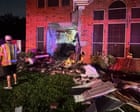
Blaming the car doesn't work anymore. For years, drivers involved in horrific accidents have pointed fingers at Tesla’s automated driving software, treating the technology as a legal shield. But a recent, tragic crash in Katy, Texas, proves the legal landscape has fundamentally shifted.
Law enforcement and prosecutors are no longer taking a driver's word for it. They are downloading the telemetry, reading the black box data, and even combing through Google search histories to prove that human recklessness, not software glitches, is responsible for fatalities.
If you think you can zone out behind the wheel and blame the machine when things go sideways, the case of Michael David Butler is a stark reality check.
The Katy Texas Tragedy
On June 19, 2026, a Tesla Model 3 barreled into a suburban home in Katy, Texas, a quiet community just outside Houston. Inside the house was 76-year-old grandmother Martha Avila. The impact was catastrophic. The vehicle breached the front wall of the residence, fatally pinning Avila inside her own home.
When first responders arrived at the chaotic scene, the driver, 44-year-old Michael David Butler, was pulled from the wreckage. While being treated by paramedics, Butler immediately offered a defense that has become common over the last decade. He claimed the car was on Autopilot. He told investigators he was making DoorDash deliveries, changed the music on his touchscreen, and eventually "passed out."
For a brief moment, it looked like another high-profile investigation into the safety of Tesla’s Full Self-Driving (FSD) suite. Then, the forensic data came back.
What the Telemetry Actually Revealed
The Harris County Sheriff’s Office didn't just accept Butler’s narrative. Investigators downloaded the vehicle’s internal data logs and reviewed dashcam footage. The electronic paper trail completely dismantled the driver's defense.
According to the arrest affidavit, Butler's Tesla was actually operating in FSD mode safely in the minutes leading up to the crash. As the vehicle approached a left turn onto Park Brush Lane, the FSD software did exactly what it was programmed to do. It slowed the car down and activated the left turn signal.
Then came the human intervention.
Data shows Butler pressed the accelerator pedal, overriding the system's default speed. Instead of allowing the car to complete the turn, Butler steadily increased pressure. Within six seconds, the accelerator input climbed to a staggering 100%.
It was pedal to the metal.
The vehicle reached 73 mph—more than double the residential speed limit. It struck a curb, became airborne, and slammed through the front wall of Avila's home. Crucially, investigators found zero evidence that Butler ever hit the brakes during the final minute before impact. There was no stuck accelerator, no floor mat interference, and no mechanical malfunction. Butler had manually overrode the safety protocols.
The Digital Smoking Gun
The prosecution’s case against Butler, who is now jailed on a second-degree felony manslaughter charge in lieu of $150,000 bail, contains an even more damning piece of evidence. Investigators recovered Google searches from Butler's phone history dating back to weeks before the crash.
The search queries were highly specific:
- "Tesla fsd not aggressive enough 2026"
- "FSD is not aggressive enough for city driving"
- "Tesla fsd too timid"
These searches provide a critical window into the driver's mindset. FSD is notoriously cautious in residential areas, a behavior often referred to as phantom braking or over-timid driving. Butler was clearly frustrated by this. Prosecutors are using these digital footprints to prove that his actions on June 19 weren't a passive medical episode where he "passed out." Instead, they argue he deliberately stomped on the gas out of sheer impatience with the car's slow, automated pace.
Tesla executives quickly capitalized on the telemetry findings. The company's vice president of artificial intelligence software, Ashok Elluswamy, noted on X that the driver manually overrode the system. CEO Elon Musk chimed in too, emphasizing that the car’s software naturally drives slowly through neighborhood streets unless forced otherwise.
The Legal Turning Point for Semi-Autonomous Cars
This case marks a massive shift in how the legal system handles semi-autonomous vehicular homicides. Historically, the confusion surrounding marketing terms like Autopilot and Full Self-Driving created a gray area. Drivers exploited this ambiguity, blaming the machine's marketing for their own lack of attention.
Not this time. The National Highway Traffic Safety Administration (NHTSA) has opened nearly 50 special investigations into Tesla crashes involving automated systems since 2016, accounting for roughly two dozen deaths. But as black box data becomes easier for local police departments to interpret, the finger-pointing stops working.
Texas law defines manslaughter as recklessly causing the death of an individual. By introducing evidence of a 100% manual accelerator override alongside search history proving premeditated frustration with the car's speed, the state has built a formidable roadmap for prosecuting distracted or impatient tech users.
Meanwhile, Avila’s family has launched a massive civil lawsuit seeking over $1 million in damages, targeting both Butler for negligence and Tesla for gross negligence, claiming the automaker fails to adequately warn the public about the defects and limitations of its driver-assistance tech.
Protect Yourself on the Road
If you operate a vehicle equipped with advanced driver-assistance systems, you need to understand your legal vulnerabilities immediately. The tech is an assistant, not a chauffeur.
- Acknowledge the Data Loggers: Your car is constantly recording your steering, braking, and accelerator inputs. If you override the system to force a risky maneuver, a digital record of that exact choice will exist forever.
- Keep Your Foot Near the Brake, Not the Gas: The moment you apply pressure to the accelerator while using FSD or Autopilot, you assume full liability for the vehicle's speed and stopping distance.
- Do Not Let Frustration Dictate Your Drive: If your vehicle’s autonomous features are driving too conservatively for your current environment, disengage the system completely and drive manually. Attempting to override or "push" the AI past its safety thresholds in a residential area invites catastrophe.