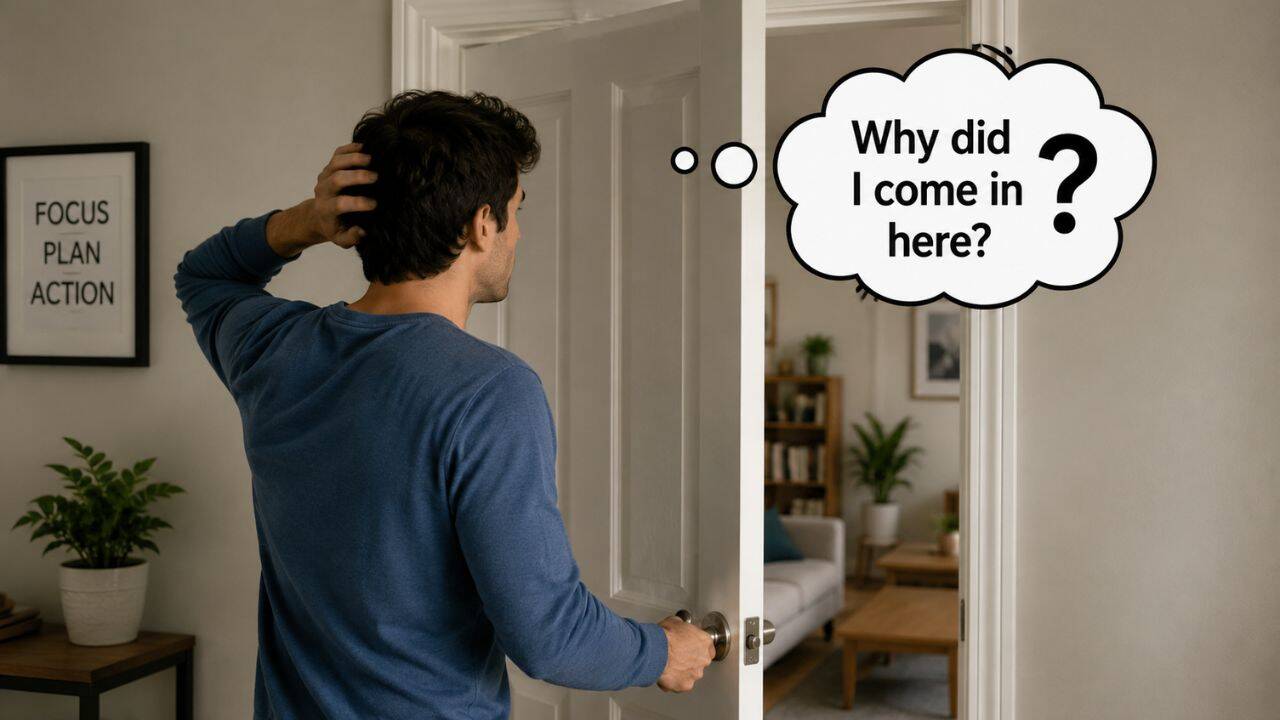
You stand in the middle of your kitchen staring blankly at the toaster. Ten seconds ago, you were on the couch, absolutely certain of your mission. Now, you have no clue why you're here. You check your pockets. Nothing. You look at the fridge. Nothing. Frustrated, you walk back to the living room, and the moment your butt hits the cushions, it hits you. You wanted scissors.
This isn't early-onset dementia. It isn't a sign that your brain is failing you. It is a highly studied cognitive glitch called the doorway effect, and it happens to almost everyone.
For years, scientists blamed the physical threshold of the door itself. They thought the simple act of passing through a frame acted as a giant eraser for short-term thoughts. But recent research has painted a far more complex picture. Your brain isn't broken. In fact, this annoying habit of forgetting your purpose is actually a byproduct of a highly sophisticated filing system designed to keep you sane.
The Notre Dame Discovery That Started It All
To understand why this happens, we have to look at the classic 2011 study conducted by Gabriel Radvansky and his team at the University of Notre Dame. They wanted to know why moving between spaces messes with our heads.
Radvansky put participants through a series of tests, both in physical environments and virtual reality setups. The task was simple. People had to pick up an object from a table, carry it across a space, and swap it for another object.
Sometimes, they walked a set distance within the exact same room. Other times, they walked that identical distance but passed through a doorway into a new room.
The results were stark.
People who crossed a threshold were significantly worse at remembering what they were carrying or what they were supposed to do next. The physical distance walked didn't matter. The only variable that triggered the memory wipe was the doorway. Radvansky and his team coined this the "location updating effect," though the public quickly branded it the doorway effect.
At the time, the conclusion seemed straightforward. Crossing a physical boundary tells the brain to flush its current workspace to prepare for a new environment. It was a clean, elegant theory.
It was also slightly incomplete.
The Plot Thickens at Bond University
In 2021, a team of researchers at Bond University in Australia, led by Oliver Baumann, decided to dig deeper. They wanted to see if they could replicate Radvansky’s dramatic results.
Using high-tech virtual reality headsets, Baumann’s team had 29 participants move through different 3D rooms to memorize various colored shapes on tables. But when they analyzed the data, they found something shocking.
Nothing happened.
The doorways didn't cause the participants to forget anything. The memory levels were essentially identical whether people stayed in the same room or crossed into a new one.
So, was the doorway effect a myth?
Not quite. Baumann realized that the original Notre Dame experiments might have succeeded because they were more taxing, or because the environments looked different. In the first Bond University trial, the virtual rooms were visually identical, and the task was relatively easy.
To test this, the researchers ran the experiment again with 45 new participants. This time, they added a twist. They overloaded the subjects’ working memory by having them do a difficult counting task in their heads while navigating the rooms.
Suddenly, the doorway effect returned with a vengeance.
When the brain was already working hard, passing through a doorway caused participants' memories to scramble. They were far more likely to make mistakes about the objects they were supposed to track.
This tells us something crucial about our daily lives. You don't forget why you went to the kitchen just because you walked through a door. You forget because you walked through a door while mentally rehearsing an email, worrying about a bill, or listening to a podcast. Your brain was already running at maximum capacity. The doorway was simply the straw that broke the camel's back.
Why Your Brain Chops Life Into Chapters
To understand why this cognitive crash occurs, we need to look at Event Segmentation Theory. This is how psychologists explain the way we perceive time and space.
Your brain does not record life like a continuous, unedited film strip. If it did, you'd quickly drown in useless data. Imagine trying to recall what you did yesterday if your brain stored every single blink, breath, and background noise with equal weight. You'd go crazy.
Instead, the brain acts like an editor in a movie production. It slices your day into neat, manageable scenes or "event models".
- Scene 1: Sitting on the couch watching TV.
- Scene 2: Walking down the hallway.
- Scene 3: Searching the kitchen cabinet.
When you are in Scene 1, your brain keeps all the information relevant to that scene in its active working memory. This is your mental clipboard. It holds your current goals, your immediate surroundings, and your physical needs.
But when you move to a new room, your brain registers a major shift in sensory input. The lighting changes. The temperature drops. The background noise shifts.
Your brain interprets this environmental shift as an "event boundary". It assumes Scene 1 is officially over and Scene 2 has begun. To save processing power, it clear-cleans the mental clipboard. It archives the data from the previous room to make space for whatever challenges or opportunities await in the next one.
The desire for scissors was tethered to the living room event model. Once you cross the threshold into the kitchen, that model is archived. The file is still on your hard drive, but it's no longer open on your desktop.
The Evolutionary Cheat Code That Backfired
Why would our brains develop such an annoying quirk? Like most strange human behaviors, this points back to survival.
Our ancestors didn't live in multi-room houses with climate control and drywall. They navigated wild, dangerous terrains. For an early human, moving from an open, sunny grassland into a dark, enclosed forest cave was a matter of life or death.
In the grassland, your brain needs to be on the lookout for distant predators, grazing herds, and dehydration.
The moment you step into the cave, those grassland priorities are useless. You need to instantly switch gears. Are there snakes on the ground? Is there a bear sleeping in the corner? Where is the exit?
An ancient human who kept worrying about a cool rock they saw in the field while stepping into a dark cave would quickly end up as predator food. The brain evolved to prioritize the immediate present. It aggressively clears out past context to ensure total situational awareness in the new environment.
The problem is that our biology hasn't caught up to our modern architecture. Your brain treats the transition from your living room to your hallway with the same evolutionary gravity as an ancient human stepping from a prairie into a forest. It resets the system to scan for threats. But instead of finding a saber-toothed tiger, you just find yourself staring blankly at your spice rack, wondering where your car keys are.
The True Limits of Your Mental Clipboard
To understand why this reset is so destructive to our thoughts, we have to talk about working memory. This is your brain's temporary holding pen.
Unlike your long-term memory, which can store a lifetime of childhood summers and song lyrics, your working memory is incredibly small. Cognitive psychologists generally agree that the average human working memory can only hold about four to seven items at a single time.
And those items are highly volatile. They require active, continuous attention to stay alive.
Think of working memory like juggling tennis balls. If you're juggling three balls (e.g., "get the scissors," "don't trip on the dog," "remember to call mom"), you can keep them in the air with some effort.
But now, walk through a door.
Suddenly, your brain detects a new scene. It throws three more balls into your juggling routine: "adjust to kitchen lighting," "avoid the open dishwasher door," "notice the dirty dishes".
You can't juggle six balls. You drop one. Unfortunately, the ball you dropped was the original reason you stood up in the first place.
How to Protect Your Thoughts From the Doorway Effect
You can't reprogram millions of years of hominid evolution, but you can outsmart your brain's filing system. Since we know that cognitive load and environmental changes are the triggers, we can use specific tactics to keep our thoughts intact.
1. Verbalize Your Mission Out Loud
It sounds silly, but talking to yourself actually works. When you stand up to get something, say it out loud: "I am going to get the scissors." Repeat it as you walk.
By speaking the goal, you use your brain's phonological loop—a component of working memory that handles auditory information. This keeps the thought active and prevents the environment-driven reset from sweeping it away.
2. Physicalize the Intention
If you are going to the kitchen to get a trash bag, make a fist or hold your hand in a specific shape that reminds you of a bag. Keeping a physical anchor engages your motor cortex. Your physical body acts as a constant, unyielding reminder of the task, which is much harder for an event boundary to erase.
3. Clear Your Mental Slate Before Moving
Most people fail because they try to multitask while moving. They stand up, start walking, and immediately pull out their phone to check a text.
Before you cross that threshold, finish your current thought. Stop checking your phone, put down your worries for a split second, and focus solely on the physical task at hand.
4. Retrace Your Steps Mentally (or Physically)
If you do forget, don't just stand there straining your brain. Go back to the room you just left.
Returning to the original environment re-triggers the event model you were just using. The cues in that room will immediately bring the archived files back to your active desktop, and you'll suddenly remember the item you wanted.
The doorway effect is a frustrating tax we pay for having highly adaptive, context-aware brains. It isn't a malfunction. It is proof that your brain is doing exactly what it was designed to do: keeping you focused on the present moment so you can survive whatever comes next. Next time you find yourself staring blankly at your fridge, take a breath, walk back to the couch, and let your brain open the old tab again.