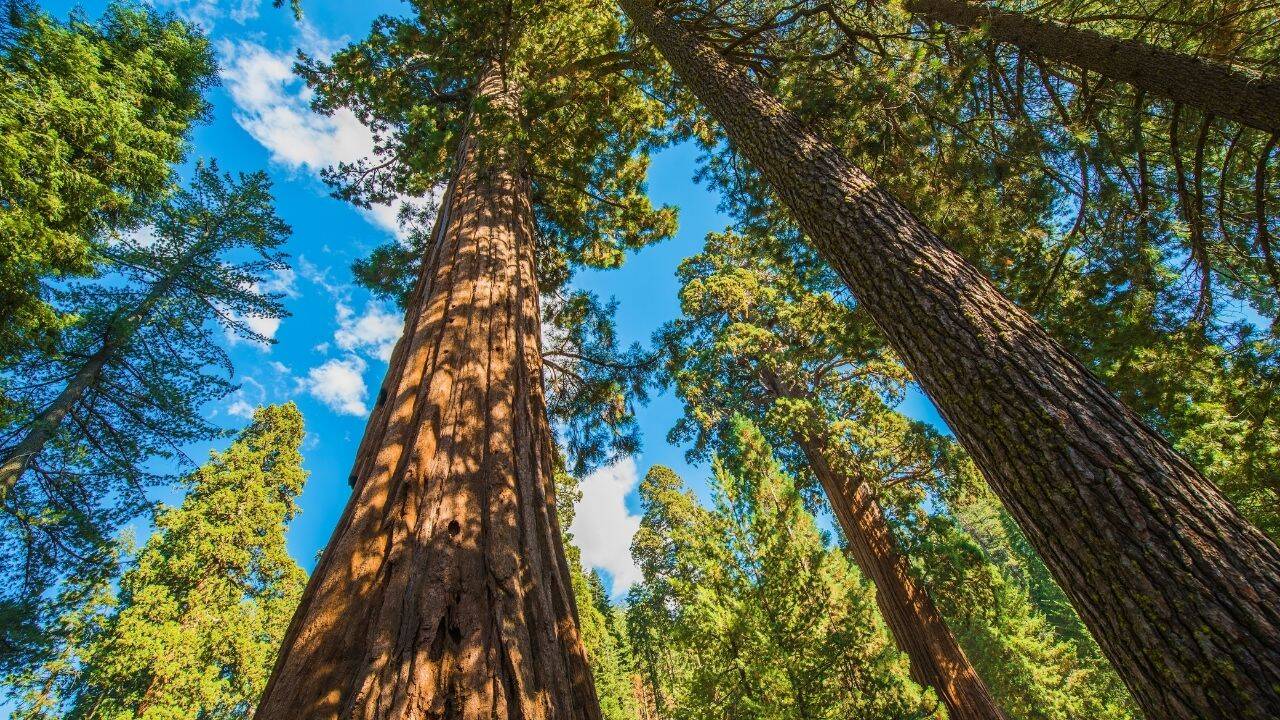
For three thousand years, giant sequoias laughed at fire. Their bark grows up to two feet thick, acting like natural insulation. Their branches hover hundreds of feet above the forest floor, far out of reach from ordinary surface flames. Fire wasn't their enemy. It was their midwife—opening waxy cones, clearing away scrub, and dropping seeds onto nutrient-rich ash.
Then two catastrophic fire seasons wiped out nearly twenty percent of all mature giant sequoias on Earth in just twenty-four months.
Between 2020 and 2021, the Castle Fire and KNP Complex Fire tore through California's Sierra Nevada. Flames didn't just crawl along the dirt. They climbed dead underbrush, turned into 150-foot walls of thermal destruction, and reached the high canopies. Ancient trees that survived the rise and fall of Roman and Ottoman empires burned from the inside out.
People panicked. Was this the end of Sequoiadendron giganteum?
A study led by UC Davis researchers and funded by NASA answers that question with concrete data. Published in Nature Communications, the research proves that prescribed burns—intentionally lighting controlled, low-intensity fires during cool weather—saved thousands of ancient sequoias during those historic blazes.
The findings aren't just academic. They give us a clear blueprint for keeping these giants alive in a warming world.
What the NASA Data Reveals About Tree Survival
For decades, forest managers insisted controlled burns worked. Critics called it counterintuitive, arguing that setting fire to a forest to protect it from fire sounded like a dangerous gamble.
The UC Davis team set out to replace anecdotal evidence with hard space-age metrics. Led by scientist Dan Dixon, researchers tracked 26,403 individual mature giant sequoias across 19 groves in Sequoia and Kings Canyon National Parks. They combined spaceborne lidar, high-resolution PlanetScope satellite imagery, and ground mapping to see which trees lived, which died, and why.
The numbers are striking.
Trees standing in groves that had received controlled burns within the prior decade were nearly four times more likely to survive extreme wildfires compared to trees in unmanaged areas. Controlled burns reduced the odds of tree death by roughly 77%.
SURVIVAL ODDS COMPARISON (2020-2021 Megafires)
---------------------------------------------------------
Untreated Forest Groves  |  [Baseline Risk]
Treated with Burns (<=10 yrs) |  4x Higher Survival Rate (77% lower mortality)
---------------------------------------------------------
According to the study's models, previous controlled burns saved roughly 1,900 mature sequoias during the 2020 and 2021 fires. Had parks managed every grove with prescribed fire prior to those blazes, another 3,900 ancient trees would still be standing today.
Think about that. Nearly 4,000 extra thousand-year-old organisms lost simply because humans didn't put enough drip torches to the ground in time.
How a Century of Fire Suppression Backfired
To fix a problem, you have to understand how we broke things in the first place.
For thousands of years, Indigenous groups like the Western Mono practiced cultural burning. They routinely set low-intensity fires to clear brush, promote plant growth for weaving and food, and manage timber. Lightning strikes also lit natural blazes every 6 to 35 years. These frequent, mild fires kept the forest floor clear.
Then came 20th-century American forestry policy.
Frightened by catastrophic timber losses, government agencies adopted total fire suppression. The policy was simple: extinguish every single woodland fire by 10 a.m. the day after discovery.
It felt responsible at the time. It was actually disastrous.
By shutting down natural fire cycles for a hundred years, humans created a ticking time bomb. Dead pine needles, fallen branches, thick brush, and millions of tiny white fir saplings accumulated on the forest floor. Forester terminology calls these "ladder fuels."
When a wildfire strikes an unmanaged forest today, it doesn't stay near the soil. Fire climbs those ladder fuels like steps on a staircase. It moves straight up into the high canopy. Once a blaze gets into the tree crown, high winds sweep flame from treetop to treetop, generating internal temperatures well above 1,000 degrees Fahrenheit.
Even a sequoia with bark like body armor can't withstand that heat. Cones in the high canopy burn up instead of opening, destroying the seed supply for future generations.
The General Sherman Example
You don't need complex computer models to see how well controlled burning works. Look at Giant Forest, home to the General Sherman tree—the largest single-stem tree on Earth by volume.
In September 2021, the KNP Complex Fire roared toward Giant Forest. Firefighters wrapped the base of General Sherman in aluminum foil as a desperate safety precaution. The media ran terrifying headlines, predicting the end of California's most famous tree.
General Sherman didn't burn. Neither did the surrounding grove.
Why? Because Sequoia National Park staff had been systematically running controlled burns through Giant Forest since the late 1960s. When the raging wildfire reached the edge of the grove, it hit a area where ground fuel had been stripped away by deliberate, low-heat burns.
The wildfire dropped from a roaring 150-foot monster in the canopy back down to a weak surface creep. Firefighters easily held the line. The ancient trees barely suffered a scorch mark.
A few miles away, in unmanaged groves like Board Camp and Alder Creek, the story ended in tragedy. Flames incinerated entire stands, leaving behind ghost forests of black, hollow spires.
Why Is Expanding Controlled Burns So Hard?
If controlled fire works so well, why aren't crews burning every square mile of forest every spring?
It turns out that lighting intentional fires is legally, logistically, and politically painful.
- Tight Atmospheric Windows: You can't just drop a match whenever you feel like it. Conditions must be dry enough for wood to catch, but humid and cool enough that crews can control the flames. Winds must be light. In California, these ideal weather windows only open for a few weeks each spring and fall.
- Air Quality Rules: Controlled burns emit smoke. Regional air districts often deny burn permits near population centers because of particulate pollution guidelines.
- Risk and Liability: If a prescribed burn escapes control and damages private homes, the agency or burn boss faces public outrage and financial liability.
- Funding and Staffing Shortages: Running a prescribed burn requires dozens of trained wildland firefighters, engines, drip torches, and safety crews. Most forestry budgets get eaten up by emergency firefighting during summer blazes, leaving little cash for spring prevention work.
Sequoia and Kings Canyon fire ecologist Tony Caprio estimated that regional forests need roughly 30,000 acres of controlled burning annually to stay healthy. On average, red tape and short budgets limit actual treatment to roughly 1,000 to 4,000 acres a year.
We are fighting a massive fuel problem with an eyedropper.
What Needs to Happen Now
We cannot suppress our way out of megafires. Climate trends bring hotter summers and longer droughts, turning thick Sierra forests into tinderboxes.
Protecting the remaining 80% of mature giant sequoias requires immediate, practical action on the ground:
- Cut Bureaucratic Red Tape: State and federal regulators must simplify smoke permit procedures during clear weather windows, allowing forestry crews to burn larger acreage quickly.
- Partner with Native Tribes: California tribes hold centuries of traditional ecological knowledge about fire timing and canopy dynamics. Expanding tribal co-management returns effective stewardship to lands that thrived under Indigenous care for millennia.
- Combine Mechanical Thinning with Fire: In heavily overgrown groves, jumping straight to prescribed burning can be too risky. Logging crews need to mechanically cut down small understory firs and clear thick logging slash first, followed by controlled surface fire.
- Fund Year-Round Prescribed Fire Squads: Instead of treating fire crews as seasonal emergency workers, agencies need dedicated, year-round teams focused exclusively on fuel reduction during off-peak months.
The choice is stark. We can pay to burn these forests on our own terms under mild, controlled conditions. Or we can watch extreme wildfires burn them down on nature's terms, destroying ancient living relics we can never replace.
Action Steps for Landowners and Advocates
If you own timberland, live in a wildland-urban interface, or want to support forest restoration, here is what you can do today:
- Create Defensible Space: Clear dead wood, leaf litter, and low hanging limbs within 100 feet of home structures. Thinning ladder fuels works on private yards just as it does in national parks.
- Support Local Prescribed Burn Associations (PBAs): Many counties have community-led PBAs that help private landowners safely conduct controlled burns with shared equipment and trained oversight.
- Advocate for Fire Use Legislation: Write to state legislators supporting bills that grant liability protections for certified burn bosses operating under approved safety plans.
- Donate to Native Seed Collections: Organizations like Save the Redwoods League are currently harvesting sequoia cones from surviving trees to replant burned-out groves where natural regeneration has failed. Supporting native seed banks helps ensure future generations can see these giants for themselves.