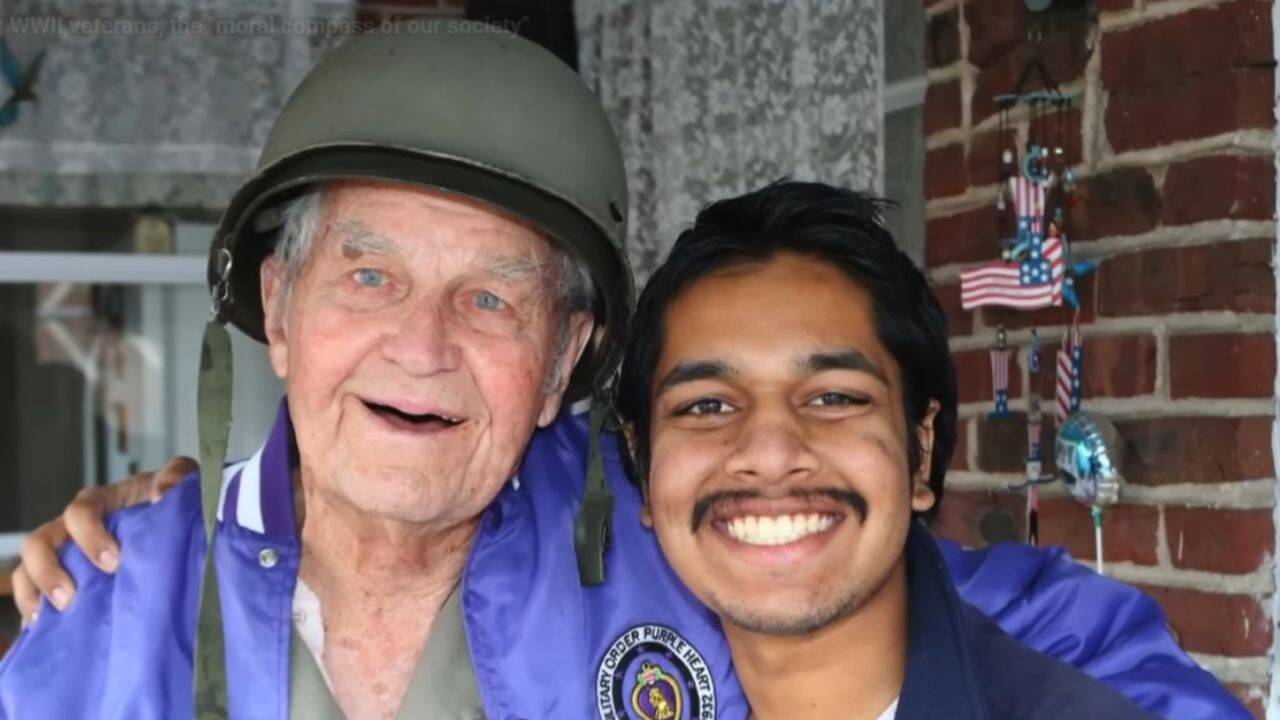
A decade ago, around 700,000 World War II veterans walked among us. Today, that number has plummeted to roughly 30,000.
Think about that. We're losing hundreds of these men and women every single day. When they die, their firsthand accounts of fighting fascism go into the ground with them. Most people watch this slow erasure of history and shrug. They figure text books or Hollywood movies will keep the memories alive.
Rishi Sharma knew better.
At just 18 years old, Sharma looked at the rapidly dwindling number of Allied combat veterans and realized someone needed to do something radical. He didn't wait for a government grant or a major media network to step in. He just grabbed a camera, hit the road, and started knocked on doors. Today, the 28-year-old Southern California native has conducted more than 3,000 deep-dive interviews with World War II combat veterans. He's traveled across all 50 US states, Canada, the UK, Australia, New Zealand, France, and Belgium.
It’s an exhausting, relentless race against time. And he’s doing it entirely on gas station food, sleeping in rental cars, and refusing a salary.
The Obsession Behind Remember WWII
Sharma didn’t grow up in a military family. His parents immigrated to the United States from India. He has zero personal ties to the American armed forces, but he has an acute sense of gratitude. He genuinely believes that the freedom his family enjoys in America exists because teenage boys bled on places like Omaha Beach and Iwo Jima.
He started small. As a high school student, he’d occasionally skip class, hop on his bicycle, and ride to local retirement homes just to listen to old men talk. By December 2016, he launched a nonprofit called Remember WWII. The mission statement was absurdly ambitious: video interview every single surviving Allied combat veteran before they pass away.
Most kids fresh out of high school are figuring out college majors or partying. Sharma chose to spend his youth living like a nomad. To keep his nonprofit funds focused entirely on travel costs, he made extreme personal sacrifices. He eats one meal a day—usually cheap snacks from a gas station. He routinely shuns hotels to sleep in the driver’s seat of rental cars.
Why put himself through that? Because he knows his subjects had it worse. He’s quick to point out that he can't complain about a cramped car seat when he’s interviewing men who lived in frozen foxholes and faced artillery fire for months on end.
Giving Families a Record That Money Can't Buy
There's no commercial angle here. Sharma doesn't monetize these raw, intimate conversations for personal gain. A typical interview doesn't last for a quick twenty minutes; he sits with these men for four to seven hours. He lets them talk without censorship. They recount the horrific, the mundane, and the deeply personal moments of their service.
Once the dust settles, Sharma gives the full, unedited video footage to the veteran’s family completely free of charge.
For many families, this is the first time they ever hear these stories. World War II veterans are notoriously quiet about their trauma. They came home, put their uniforms in the closet, and went to work. They didn't boast. Many never told their children what they saw. Sharma has a knack for breaking through that stoic shell.
Take his recent interview with 100-year-old Marine veteran Nils Mockler in Yorktown, New York. Mockler was a combat intelligence scout whose first taste of war was the meat grinder of Iwo Jima. When Sharma asked him what it felt like to witness the American flag being raised on Mount Suribachi, Mockler admitted that the hair on his arms still stands up just thinking about how beautiful it was.
Another interview featured 100-year-old Vernon Brantley in South Carolina, who sat at his kitchen table eating homemade chicken noodle soup with Sharma, recounting how he was drafted at 18 and simply saw the war as a mandatory obligation that every young man had to fulfill.
What We Lose When the Greatest Generation Is Gone
We just marked America’s 250th anniversary. It’s easy to celebrate big milestones with fireworks and speeches, but Sharma’s work forces us to confront a uncomfortable reality. The liberty we take for granted wasn't an accident. It was bought by a generation characterized by an intense sense of sacrifice and moral clarity.
Sharma doesn't just collect war stories for the sake of military trivia. He’s hunting for wisdom. He notes that almost every veteran he meets possesses a distinct sense of humor and an absence of malice. These individuals faced the absolute worst of humanity, yet they returned home to build families, volunteer, and quietly steer the communities around them.
When the last World War II veteran dies—which experts predict will happen within the next decade—we don't just lose historical data. We lose the literal moral compass of modern society. We lose the living embodiment of putting country and community above self.
How to Help Preserve This History Right Now
Time is the ultimate enemy of this project. The youngest surviving combat veterans are now 97 or 98 years old. If you want to ensure these voices aren't permanently silenced, you can take immediate action.
- Flag a Veteran: If you know a living World War II combat veteran who hasn't documented their story, you can contact Sharma’s organization directly by calling or texting 818-584-4309 or 202-315-8743.
- Fuel the Mission: Sharma runs his entire operation on grassroots donations. Every dollar goes straight toward flights, rental cars, and camera equipment. You can back his project through his official website at rememberww2.org.
- Hear Their Voices: Stop watching fictionalized Hollywood versions of the war. Go watch the real men tell their stories on his YouTube channel, Remember WWII with Rishi Sharma, which hosts hundreds of hours of raw oral history.